
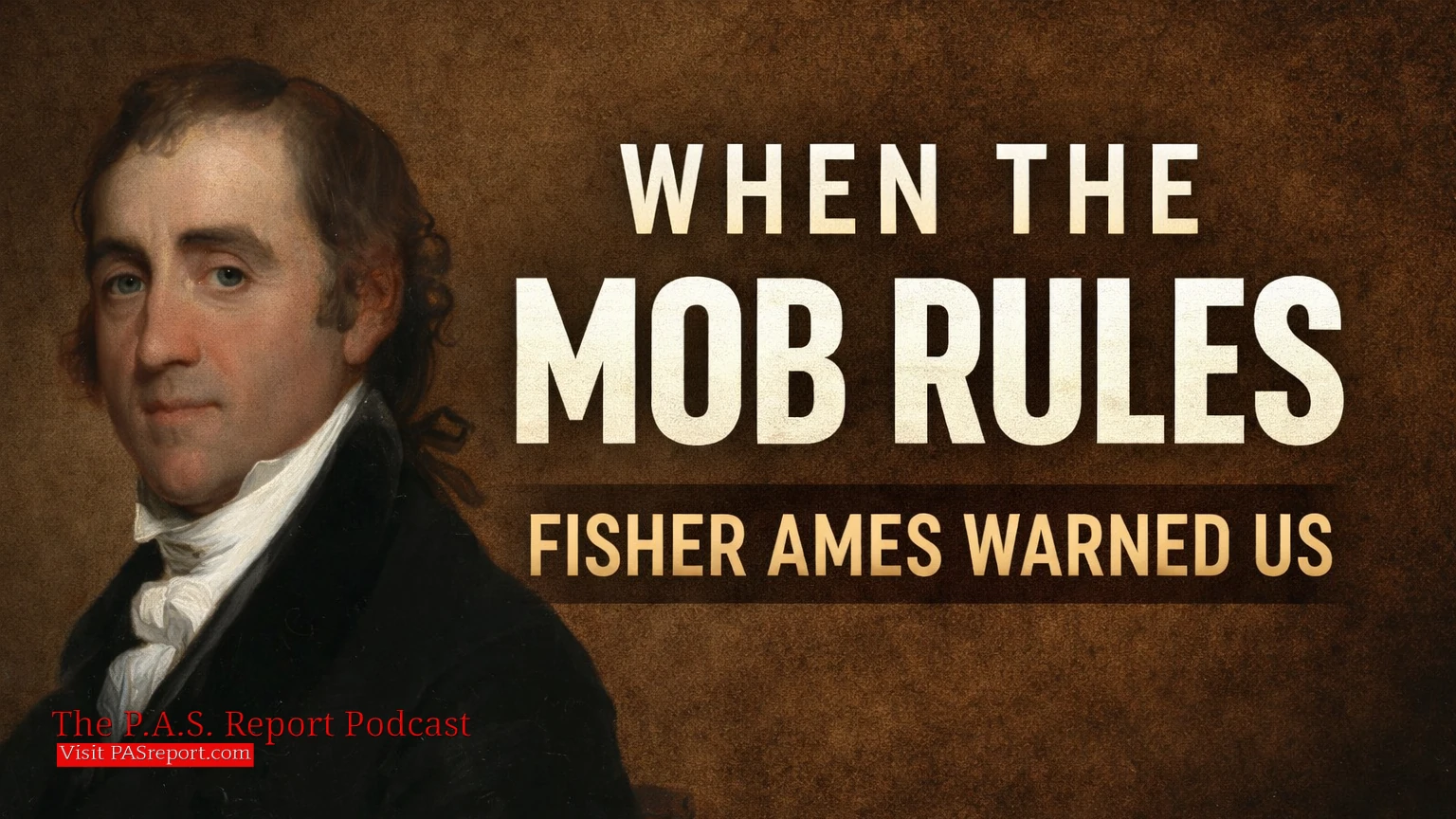
↓ The P.A.S. Report Podcast is on every podcast platform! ↓


Episode Description
Fisher Ames didn’t just worry about democracy, he despised it.
In this episode of America’s Founding Series, the life and ideas of Fisher Ames reveal why the Founders feared mob rule, moral absolutism, and political urgency driven by emotion rather than reason. Ames believed liberty survives only when passion is restrained by law, time, and reflection. As modern mobs reject disagreement, delegitimize institutions, and claim authority over the law itself, his warnings feel less like history and more like prophecy.
What You’ll Learn
- Why Fisher Ames believed democracy is driven by impulse, not reason
- The difference between citizens and mobs, why disagreement becomes betrayal, and the impact of social media on polarization and the mob mentality
- How the Constitution was designed to slow emotional surges before they become law
- Why gridlock is a feature, not a flaw, in a functioning republic
- How moral certainty and urgency lead societies toward instability and despotism
This episode connects America’s founding principles to modern unrest and explains why a republic cannot survive when mobs replace law and emotion replaces judgment.
📲 Subscribe to The P.A.S. Report’s America’s Founding Series to learn about forgotten patriots and the untold stories that shaped the fabric of America.
Click play above to listen to the entire episode or you can listen on any podcast platform
00:52 The Fear of the Mob’s Truth
01:53 Fisher Ames: A Founding Voice of Caution
04:14 The Dangers of Impulse in Democracy
07:46 Human Behavior and Political Urgency
09:41 The Erosion of Law and Order
11:36 The Subjectivity of Truth in Modern Society
14:18 Democracy vs. Republic: A Foundational Debate
Fisher Ames Warned About Democracy and Mob Rule. Here’s Why It Matters Now
You can feel it everywhere. Public debate no longer feels like debate. Questioning the crowd feels dangerous. Pausing to ask for evidence feels risky. You are expected to choose a side immediately, affirm the moral certainty of the moment, and move on. When emotion moves faster than thought, disagreement stops being tolerated and starts being punished. You are not imagining this shift. You are living inside it.
This tension is not new. It was predicted at the founding. In this episode of The P.A.S. Report Podcast: America’s Founding Series, we dive deep into the life and warnings of Fisher Ames, a largely forgotten Founder who feared that unchecked democracy would devolve into mob rule and ultimately destroy liberty itself. His ideas explain why political urgency feels suffocating today and why restraint, delay, and disagreement were intentionally built into the American system.
Why Fisher Ames Feared Democracy Driven by Emotion
Fisher Ames believed that democracy was uniquely vulnerable to passion. When public opinion is driven by impulse rather than reason, crowds stop thinking like citizens and begin acting like mobs. Ames warned that moral certainty is the most dangerous force in politics because it treats hesitation as betrayal and disagreement as evil. Once a crowd believes it is righteous, law becomes optional and restraint becomes a threat.
What the Founders Built to Slow the Mob
The Constitution was not designed for speed or efficiency. It was designed as a filter. Multiple branches, staggered elections, and institutional friction were deliberate safeguards meant to cool emotional surges before they became permanent law. What many people dismiss today as gridlock was understood by the Founders as protection. Fisher Ames believed time itself was a defensive mechanism that allowed reason to catch up with passion.
How Mob Rule Leads to the Loss of Liberty
Ames warned that when crowds claim authority over the law, instability follows. Disorder invites force. Force invites despotism. The great irony is that people seeking freedom through mass emotion often end up surrendering it. When truth becomes subjective, and urgency replaces deliberation, liberty erodes quietly, not through conquest but through consent.
Curiosity Gap
Why did Fisher Ames believe mobs inevitably invite tyranny
How did the Founders distinguish citizens from crowds
Why delay and disagreement protect liberty rather than threaten it
How moral certainty accelerates political instability
What happens when objective truth disappears from public life
⬇️⬇️⬇️
Listen to the full episode now on Apple Podcasts, Spotify, or your favorite podcast platform.
⬆️⬆️⬆️
Subscribe to the podcast and share this episode to help more people rediscover the forgotten patriots who built the foundation of the United States.
The P.A.S. Report wants to hear from you. Send your feedback to podcast@pasreport.com. Please leave a 5-star rating and write a review on Apple Podcasts.
Protect your privacy online with PureVPN

Online privacy is not optional. A VPN helps keep browsing more private by encrypting internet traffic, masking an IP address, and reducing exposure on public Wi-Fi. It also helps limit tracking and can support access to content when networks block or restrict it.
✅ Encrypts Your Data & Internet Traffic for Added Privacy
✅ Masks Your IP Address & Location
✅ Bypasses Geo-Restrictions & Censorship
✅ Helps Secure Public Wi-Fi Connections
*Disclosure: This site contains affiliate links. If a purchase is made through these links, PA Strategies, LLC may earn a commission at no additional cost to the buyer.
Please share this episode with others & on social media.