

Episode Description
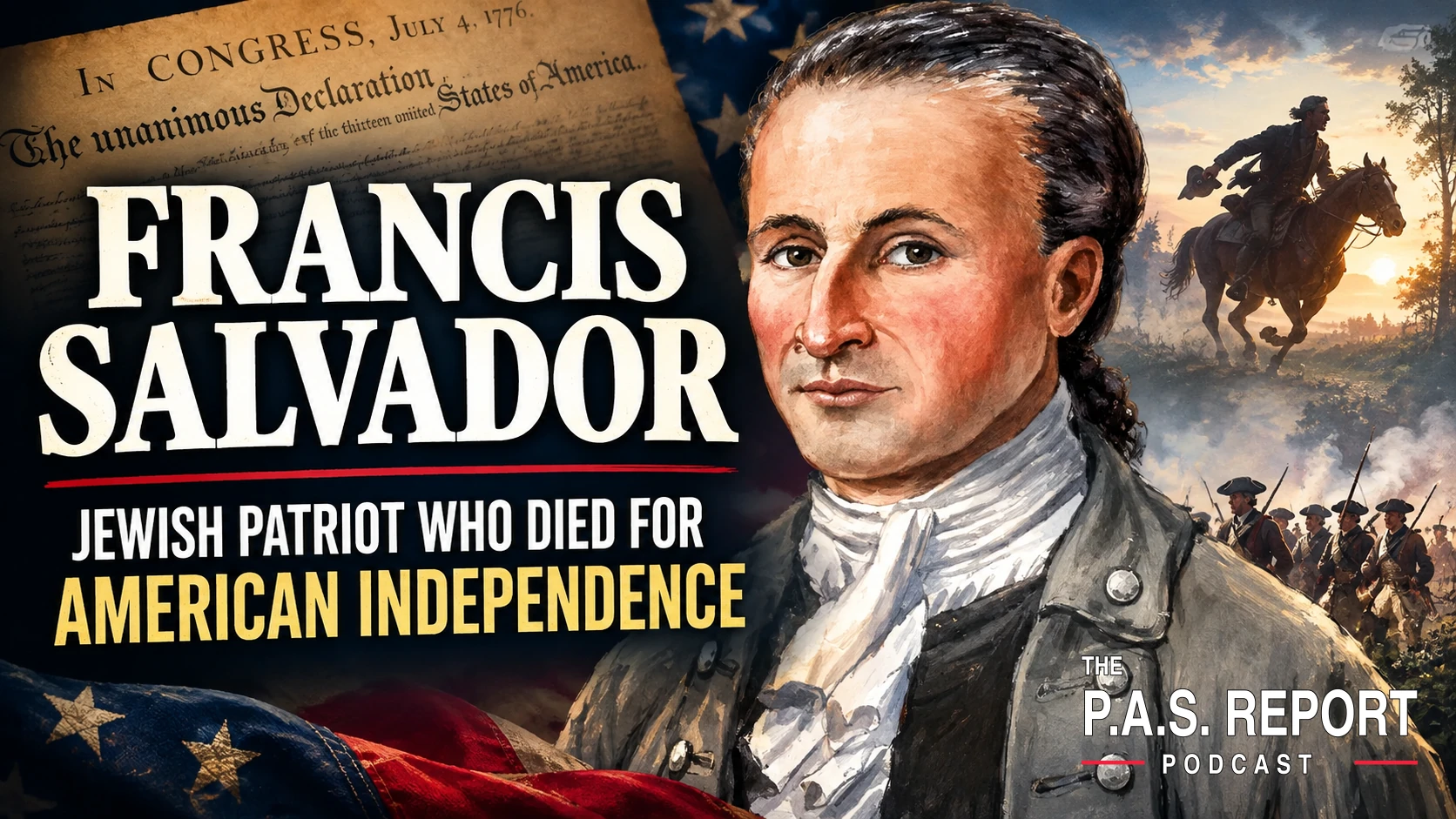
Francis Salvador spent less than three years in America before he died for independence. Why did this Jewish patriot risk everything?
In this episode of America’s Founding Series on The P.A.S. Report Podcast, Professor Nick Giordano tells the extraordinary story of Francis Salvador, the “Southern Paul Revere,” who rose from Jewish immigrant to revolutionary leader in South Carolina. Discover how Salvador broke religious barriers, helped advance the American Revolution, and became the first known Jewish Patriot to die for American independence at the Battle of Esseneca in 1776. As America marks the 250th anniversary of the Declaration of Independence, his sacrifice raises a question too few Americans can answer: What makes someone an American? His story connects the American Revolution, natural rights, the Declaration of Independence, and the U.S. Constitution to a timeless principle: liberty requires personal responsibility, not government compulsion.
What You’ll Learn In This Episode:
- Francis Salvador’s Forgotten Sacrifice: Why a Jewish immigrant with no American ancestry risked his fortune and life for independence after less than three years in the colonies.
- The First Jewish Patriot in Colonial Politics: How Salvador overcame religious barriers to become the first openly Jewish member of an American representative assembly.
- The Southern Paul Revere and Battle of Esseneca: Why Salvador rode nearly 30 miles to alert Patriot militia forces and what eyewitness accounts reveal about his final moments.
- The Declaration of Independence and American Liberty: Why the Founders pledged their lives, fortunes, and sacred honor to the principles of liberty and to one another.
- American Identity vs. Identity Politics: Why the American creed rests on natural rights, constitutional principles, individual liberty, and personal responsibility rather than ancestry or allegiance to government.
⭐ Help Keep Authentic American History Alive:
If you believe the sacrifices that built this nation must never be forgotten, follow The P.A.S. Report Podcast, leave a 5-star rating on Apple Podcasts or Spotify, and text a link to this episode to 3 or 4 friends and family members right now.
Click play above to listen to the entire episode or you can listen on any podcast platform
00:00 What Makes Someone an American? Francis Salvador’s Story
01:30 Francis Salvador’s Journey from London to Colonial America
04:34 Francis Salvador Becomes America’s First Jewish Legislator
09:23 The Southern Paul Revere and His Daring 28 Mile Ride
13:27 The Battle of Esseneca and Francis Salvador’s Final Sacrifice
16:26 The American Creed: Declaration of Independence and Liberty
18:25 American Identity and Our Responsibility to Defend Freedom
Francis Salvador: The Jewish Patriot Who Defined American Liberty Through Sacrifice
What makes someone an American? If you struggle to answer that question, you’re not alone. As America celebrates the 250th anniversary of the Declaration of Independence, too many citizens struggle to explain the principles that define our national identity. Is it ancestry, birthplace, or citizenship alone? Or does something far more consequential bind Americans together? Francis Salvador, a Jewish immigrant who sacrificed his life for American independence after less than three years in the colonies, offers a remarkable answer. In this episode of The P.A.S. Report Podcast, we dive deep into Salvador’s forgotten story as Professor Nick Giordano explores the American Revolution, the meaning of liberty, and the individual responsibility that sustains our constitutional republic.
Francis Salvador: The Jewish Immigrant Who Became a Revolutionary Patriot
Francis Salvador arrived in South Carolina in 1773 with hopes of rebuilding his family’s lost fortune. Born into a prominent Sephardic Jewish family in London, Salvador faced a colonial society that maintained religious restrictions and political exclusions. Yet within barely a year, he won election to South Carolina’s Provincial Congress, becoming the first openly practicing Jew known to serve in an American representative assembly. He helped organize colonial resistance, advanced the cause of independence, and participated in the development of South Carolina’s first state constitution. His political rise challenges conventional assumptions about the American founding and reveals how the fight for liberty attracted individuals from different religious and cultural backgrounds, even as colonial society denied equal rights to many.
The Southern Paul Revere and Francis Salvador’s Final Battle
As the American Revolutionary War engulfed South Carolina in 1776, Salvador faced a choice that would determine his legacy. When Cherokee attacks threatened frontier settlements, he rode approximately 28 miles to alert militia commander Andrew Williamson, earning the nickname “Southern Paul Revere.” Rather than return to the relative safety of his plantation, Salvador joined the Patriot militia. On August 1, 1776, the Battle of Esseneca claimed his life at just 29 years old, making him the first known Jewish Patriot to die for American independence. His final moments, preserved through an eyewitness account, reveal an extraordinary act of courage and raise a powerful question: Why would a man with no generations-long colonial ancestry sacrifice everything for a country that had barely declared its independence?
American Identity, the Declaration of Independence, and the Meaning of Liberty
Francis Salvador’s sacrifice offers a lesson that resonates amid today’s identity politics, tribalism, and civic ignorance. The American creed does not demand common bloodlines, ethnicity, religion, or unquestioned allegiance to government. The Declaration of Independence articulates the principles of natural rights, human equality, and government by consent, while the U.S. Constitution establishes the framework for limited government and the protection of individual liberty. The Declaration’s final pledge of lives, fortunes, and sacred honor reflects something essential: individuals must freely accept personal responsibility for liberty and for their obligations to one another. Salvador lived that principle, even though he likely never learned that Congress had formally declared independence. His story challenges modern Americans to ask whether they still understand the ideals that make the American experiment possible.
What You Won’t Want to Miss
- The immigrant who broke colonial barriers: How Francis Salvador rose to political leadership despite religious restrictions.
- The Southern Paul Revere: What prompted Salvador’s desperate ride across the South Carolina frontier?
- The final moments of a forgotten Patriot: What did Salvador ask Andrew Williamson as he lay mortally wounded after the Battle of Esseneca?
- The Founders’ sacred pledge: Why does the Declaration’s final sentence reveal something essential about American identity?
- The responsibility of liberty: What does Salvador’s sacrifice reveal about the principles that Americans must voluntarily uphold?
Subscribe to the podcast and share this link to help more people rediscover the forgotten patriots who built the foundation of the United States.
The P.A.S. Report wants to hear from you. Send your feedback to podcast@pasreport.com. Please leave a 5-star rating and write a review on Apple Podcasts.

Please share this episode with others & on social media.