
↓ The P.A.S. Report Podcast is on every podcast platform! ↓


Episode Description
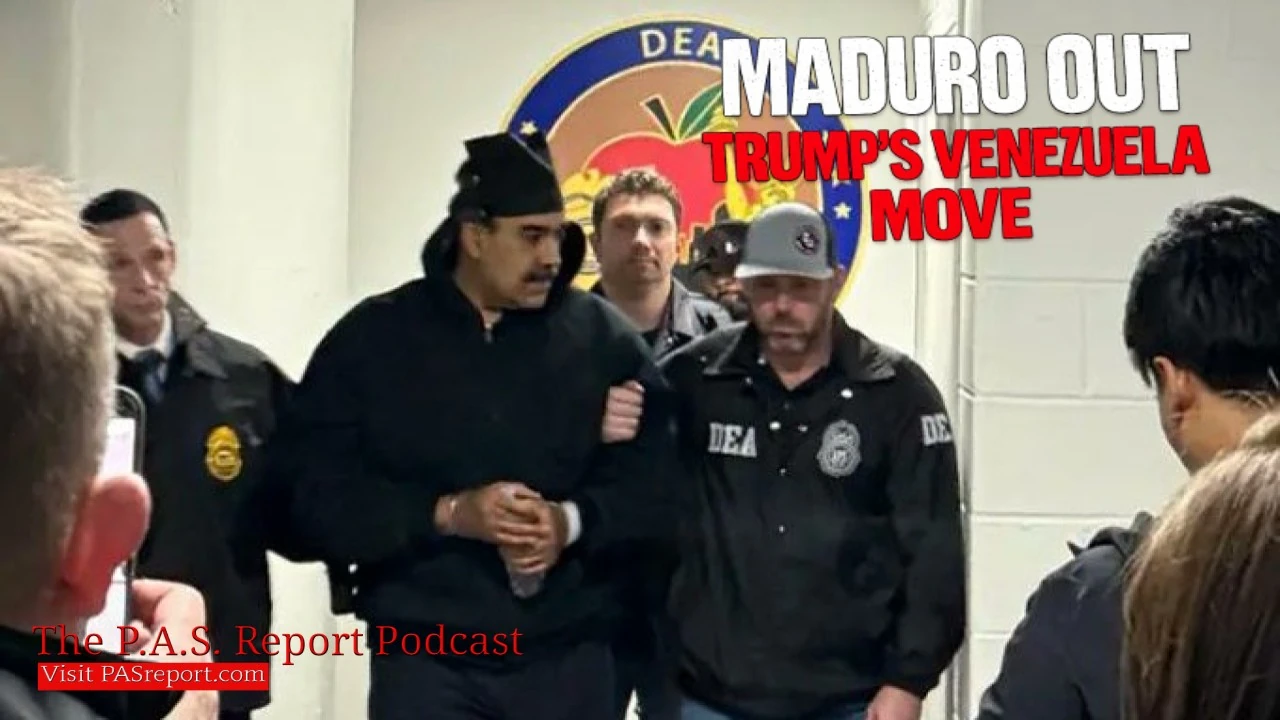
In this episode of The P.A.S. Report Podcast, Professor Nick Giordano breaks down the stunning takedown and arrest of Venezuela’s Nicolás Maduro and why it may signal a major shift in U.S. power in the Western Hemisphere. Was this a smarter model than the failed regime-change disasters of Iraq, Afghanistan, and Libya, or the beginning of a dangerous new era of presidential authority? Professor Giordano examines what happens next as President Trump says the U.S. will run Venezuela until a safe, competent transition is possible, the strategic stakes tied to oil and hemispheric control, and the constitutional and international-law arguments now colliding in real time. He also exposes the domestic political hysteria as Venezuelans celebrate while America’s activist left rushes to defend Maduro, revealing how Trump Derangement Syndrome continues to warp reality.
Episode Highlights
- Maduro captured, Venezuela in play: why this operation was different, what comes next, and the risk of repeating past postwar transition failures
- Monroe Doctrine 2.0: how oil, energy leverage, and strategic denial of Russia, China, Iran, Cuba, and proxy networks reshape geopolitics in the Americas
- Legality and backlash: Article II authority, Congress’s war-powers abdication, “international law” myths, and the left’s bizarre defense of Maduro driven by anti-Trump obsession
📲 Subscribe, listen, and share The P.A.S. Report Podcast to stay informed on the latest political issues shaping America.
Click play above to listen to the entire episode or you can listen on any podcast platform
Timestamps
- 00:52 Historical Implications of Regime Change as Trump Moves on Maduro
- 02:30 Differences in Military Operations
- 03:48 Success vs. Policy Outcomes
- 04:45 Trump’s Approach to Regime Change
- 06:25 Lessons from Past Interventions
- 08:09 Public Sentiment on Foreign Policy
- 08:45 The Future of U.S. Involvement in Venezuela
- 13:34 Challenges Ahead for U.S. Policy
- 13:59 The Shift in U.S. Strategy
- 19:09 Potential Pitfalls of U.S. Involvement
- 23:19 Aligning Means with Ends
- 24:36 Geopolitical Motivations Behind the Operation
- 26:21 Reestablishing the Monroe Doctrine
- 27:36 Foreign Influence in Latin America
- 29:15 China and Russia’s Strategic Interests
- 31:26 The Role of Non-State Actors
- 33:24 Venezuela’s Oil Reserves and Geopolitical Power
- 36:22 Domestic Reactions and Political Ramifications
- 40:00 Legal and Constitutional Considerations
Maduro Out: Trump, Venezuela, and the Real Geopolitical Prize
Venezuela woke up to a seismic shift as Nicolás Maduro was reportedly taken down in a rapid, tightly scoped operation that instantly changed the strategic landscape in the Western Hemisphere. For decades, the words regime change have been synonymous with prolonged wars, vague objectives, and disastrous outcomes. This time, the situation appears fundamentally different, not because the stakes are lower, but because the method and the target were narrowly defined. The immediate question is not whether Maduro deserved to go. The question is whether the United States can convert a dramatic operational success into a durable political outcome that strengthens both Venezuela and American interests.
One of the most consequential developments is President Trump’s stated intention that the United States will run Venezuela until a safe and competent transition can occur. That approach departs from past interventions where power was handed to transitional leaders who lacked competence, legitimacy, or alignment with U.S. objectives. In Iraq and Afghanistan, American forces remained for years, even decades, while local political actors pursued their own ambitions, empowered their own factions, and frequently undermined the very mission America was trying to accomplish. Premature handoffs did not shorten those conflicts. They complicated them, prolonged them, and helped turn tactical victories into strategic disappointments.
The larger story extends well beyond narcotrafficking and an arrest warrant. Venezuela sits atop one of the most significant proven oil reserve bases in the world, and its strategic value is inseparable from great power competition. Russia, China, Iran, and Cuba have all sought deeper footholds in Latin America, exploiting American drift and bureaucratic paralysis. Reasserting American influence in the hemisphere signals a return to strategic realism, where adversaries are denied access and leverage in regions that directly affect U.S. security. Energy infrastructure and productivity become geopolitical tools, not merely economic assets, shaping global leverage without firing a shot.
Yet none of this escapes the constitutional and political storm at home. The president’s Article II authority, Congress’s long record of ceding war powers, and decades of precedent have created a constitutional gray zone that is neither unprecedented nor clean. At the same time, the loudest voices invoking international law often treat it as an absolute when it restrains America, and as an afterthought when it restrains adversaries. Predictably, Venezuelans and members of the diaspora have celebrated Maduro’s removal while activist groups in the United States have rushed to condemn the operation and even defend the regime. The episode breaks down the legal arguments, the strategic stakes, and the domestic hysteria, with one central test looming over everything: can a tactical victory become a lasting policy success without repeating the failures of the past? Be sure to tune in.
🎧 Listen to the full episode now
👉
📢 Subscribe to the podcast and leave a 5-star review
✅ Share the Episode
If you believe in free speech, civil liberties, and accountable government, share this episode with your network. Help spread the word about the threat posed by unchecked federal power and what can be done to stop it.
Protect your privacy online with PureVPN

Online privacy is not optional. A VPN helps keep browsing more private by encrypting internet traffic, masking an IP address, and reducing exposure on public Wi-Fi. It also helps limit tracking and can support access to content when networks block or restrict it.
✅ Encrypts Your Data & Internet Traffic for Added Privacy
✅ Masks Your IP Address & Location
✅ Bypasses Geo-Restrictions & Censorship
✅ Helps Secure Public Wi-Fi Connections
*Disclosure: This site contains affiliate links. If a purchase is made through these links, PA Strategies, LLC may earn a commission at no additional cost to the buyer.
Don’t forget to check out the New Contract With America and listen to the 3-part series to hear solutions to the problems America faces.
*PA Strategies, LLC. may earn advertising revenue or a small commission for promoting products or when you purchase through any affiliate links on this website and within this post.