
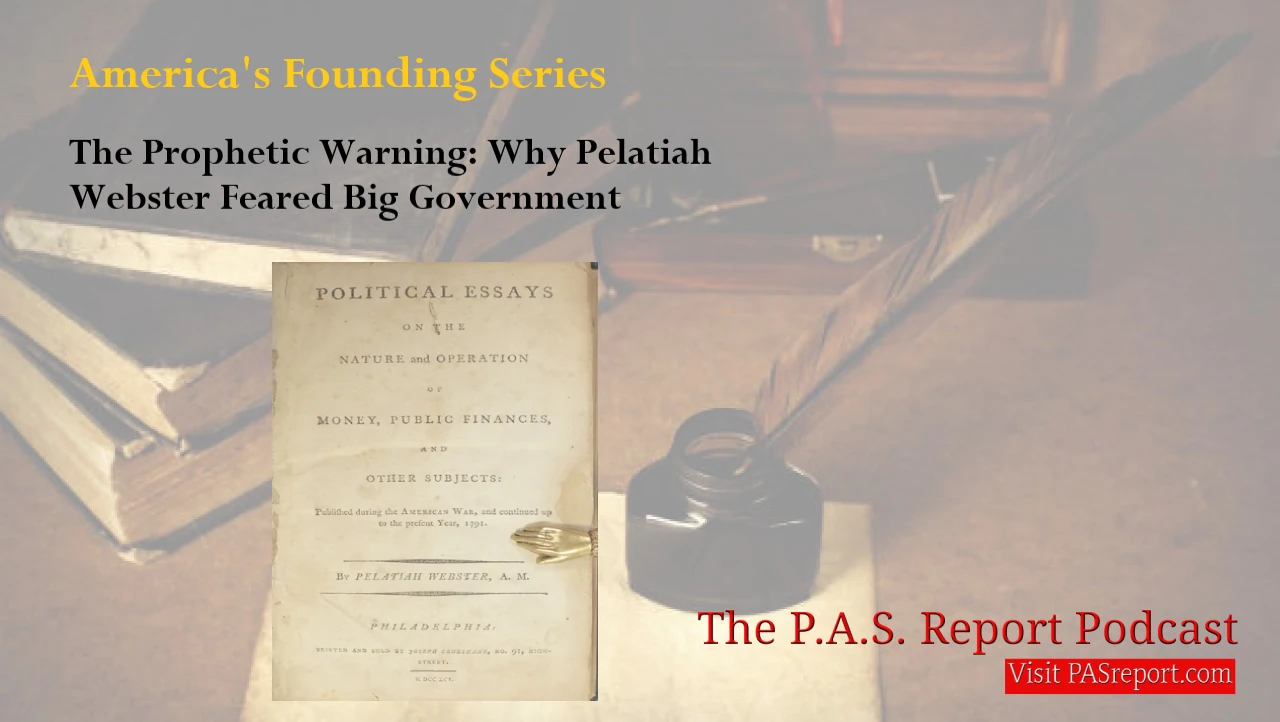
↓ The P.A.S. Report Podcast is on every podcast platform! ↓


Episode Description
In this episode of America’s Founding Series on The P.A.S. Report Podcast, Professor Nick Giordano tells the riveting story of Pelatiah Webster, the clergyman-turned-economist, who saw America’s future more clearly than anyone of his time. As the young republic teetered on collapse in 1781, Webster’s bold vision for limited government, sound money, and individual enterprise laid the groundwork for the U.S. Constitution and the free-market system that built the nation. His warnings about inflation, dependency, and centralized control echo today as socialism and big-government promises sweep through modern politics.
Episode Highlights
- How Pelatiah Webster’s 1781 blueprint inspired Madison and Hamilton and helped shape the U.S. Constitution.
- Why Webster’s fight against debt, inflation, and dependency remains a direct warning to today’s socialist and big-government movements.
- What Webster taught about freedom and property rights and why capitalism, not government control and socialism, is the true guardian of liberty.
📲 Subscribe to The P.A.S. Report’s America’s Founding Series to learn about forgotten patriots and the untold stories that shaped the fabric of America.
Click play above to listen to the entire episode or you can listen on any podcast platform
00:52 The Rise of Big Government and Socialism
02:50 Economic Collapse and the Articles of Confederation
05:12 Webster’s Vision for a Limited Government
08:07 The Connection Between Economics and Liberty
10:23 Warnings Against Government Dependency
12:41 The Legacy of Webster and the Constitution
Pelatiah Webster: The Forgotten Economist Who Saw America’s Future
Most Americans have never heard the name Pelatiah Webster, yet his ideas helped rescue a collapsing nation and guide the creation of the United States Constitution. His warnings about the dangers of unchecked government power, runaway debt, and economic dependency ring louder today than they did more than two centuries ago. At a time when America was on the brink of financial ruin and political chaos, Webster stepped forward with a bold vision for a free, prosperous, and stable republic.
The year was 1781. The American Revolution was far from over, and the dream of independence was steadily slipping away. Soldiers were unpaid. Paper money had become worthless. States were acting in their own self interest, creating trade disputes and economic turmoil. In the middle of this crisis, Webster retreated into a small Philadelphia study and began writing a series of essays that challenged the failing system and offered a blueprint for recovery. He believed that liberty and economic stability were inseparable, and that a nation could not survive on promises, emotion, or government decrees. It needed structure, accountability, and a respect for private property.
Webster saw firsthand how easily people could be tempted by quick fixes, such as the printing of endless paper money or government mandates that forced farmers and merchants into unnatural compliance. He understood that these ideas might feel good in the short term, but they would eventually destroy the very freedoms Americans were fighting to secure. His work, including his groundbreaking 1783 Dissertation on the Political Union and Constitution of the Thirteen United States, circulated among the leading minds of the era and laid out many of the concepts that would later appear in the Constitution.
Today, as modern politicians promise government solutions for every problem in society, Webster’s warnings carry renewed weight. He understood that freedom disappears not through sudden tyranny but through gradual dependence. He knew that when citizens trade personal responsibility for government protection, the balance shifts from liberty to control. His life and work serve as a reminder that the American commitment to individual enterprise, sound money, and limited government has always been the foundation of our national strength.
Pelatiah Webster may not appear in most history books, but his ideas helped shape the very structure of the United States. His legacy invites us to examine the role of government today and to ask whether we are still committed to the principles that built this country. To hear the full story and understand why his message is more urgent than ever, listen to the latest episode of the America’s Founding Series on The P.A.S. Report Podcast.
🎧 Listen to the full episode now on Apple Podcasts, Spotify, or your favorite podcast platform.
➡️ Subscribe to the podcast and share this episode to help more people rediscover the forgotten patriots who built the foundation of the United States.
The P.A.S. Report wants to hear from you. Send your feedback to podcast@pasreport.com. Please leave a 5-star rating and write a review on Apple Podcasts.
Please share this episode with others & on social media.
Protect your privacy online with PureVPN

Online privacy is not optional. A VPN helps keep browsing more private by encrypting internet traffic, masking an IP address, and reducing exposure on public Wi-Fi. It also helps limit tracking and can support access to content when networks block or restrict it.
✅ Encrypts Your Data & Internet Traffic for Added Privacy
✅ Masks Your IP Address & Location
✅ Bypasses Geo-Restrictions & Censorship
✅ Helps Secure Public Wi-Fi Connections
*Disclosure: This site contains affiliate links. If a purchase is made through these links, PA Strategies, LLC may earn a commission at no additional cost to the buyer.
*PA Strategies, LLC. may earn advertising revenue or a small commission for promoting products or when you purchase through any affiliate links on this website and within this post.