↓ The P.A.S. Report Podcast is on every podcast platform! ↓


Episode Description
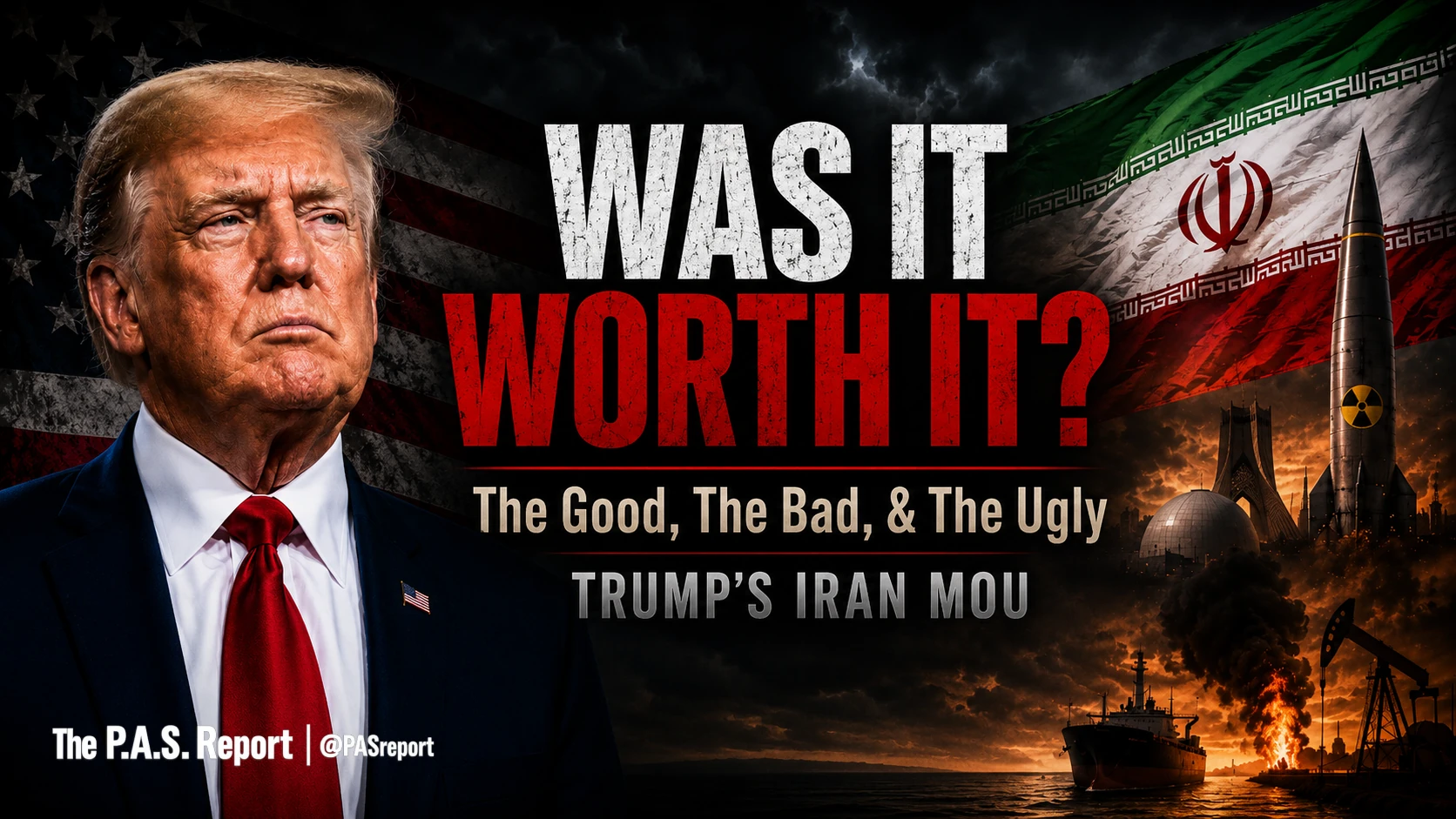
Iran War analysis takes center stage as Professor Nick Giordano breaks down whether Trump’s Iran MOU represents strategic victory, dangerous ambiguity, or a temporary pause that gives Tehran time. The real question is simple: Did America force the outcome it wanted, or did Iran survive long enough to make Washington soften its demands?
In this episode of The P.A.S. Report Podcast, Professor Giordano examines the good, the bad, and the ugly of Trump’s Iran MOU. He explains how the U.S. military shattered Iran’s military capabilities, why the Strait of Hormuz and strategic oil reserves changed the equation, and how Tehran may use enriched uranium, proxy networks, and economic pressure to shape the final outcome.
What You’ll Learn In This Episode:
- Why the Iran War weakened Tehran’s military, air force, navy, missile systems, and drone capabilities
- How Trump’s Iran MOU creates serious concerns over vague language, sanctions relief, proxy loopholes, and the Strait of Hormuz
- Why highly enriched uranium remains the ultimate test of whether America achieved real victory or merely delayed the threat
- How Iran may use Hezbollah, the Houthis, and other proxies as bargaining chips for sanctions relief
- Why China, Russia, North Korea, and terrorist networks may study this conflict as a blueprint for making America blink
Was the Iran War worth it? The answer depends on whether Trump’s MOU locks in American leverage or allows Iran to stall, rebuild, and claim survival.
Topics covered: Iran War, Trump Iran MOU, Strait of Hormuz, Iran nuclear program, highly enriched uranium, sanctions relief, Iran proxy networks, Hezbollah and the Houthis, strategic oil reserves, Middle East conflict
📲 Connect with the Show and take a moment to share this episode with friends, family, and colleagues, and leave a 5-star rating and review on Apple Podcasts or Spotify.
Click play above to listen to the entire episode or you can listen on any podcast platform
Timestamps
- 00:00 Was the Iran War Worth It?
- 05:08 How U.S. Forces Crippled Iran’s Military
- 12:43 Trump’s Iran MOU: The Good, the Bad, and the Ugly
- 20:43 Why Time Helps Iran Stall and Regroup
- 25:53 Iran’s Proxy Loophole: Hezbollah, Houthis, and Sanctions
- 32:05 Strait of Hormuz, Oil Reserves, and Global Economic Pressure
- 36:06 Did America Force Victory or Let Iran Survive?
Was the Iran War Worth It? How Trump’s Iran MOU Could Reshape the Middle East
You hear the slogans from every direction. One side says President Trump won. Another says he surrendered. The media pushes Tehran’s narrative, but the Iran War and Trump’s Iran MOU demand a deeper look. If you want to understand whether America actually forced Iran to capitulate or merely gave Tehran time to stall, this episode breaks down the question that matters most: was the Iran War worth it?
In this episode of The P.A.S. Report Podcast, we dive deep into the good, the bad, and the ugly of Trump’s Iran MOU. Professor Nick Giordano examines how U.S. military force devastated Iran’s military capabilities, why the Strait of Hormuz and strategic oil reserves changed the geopolitical equation, and how Iran may use enriched uranium, sanctions relief, and proxy networks as leverage in future negotiations. This is not partisan cheerleading or media panic. It is a hard look at battlefield success, diplomatic ambiguity, and the dangerous lessons America’s enemies may take from this conflict.
Why the Iran War Weakened Tehran but Did Not End the Threat
The U.S. military campaign shattered major parts of Iran’s military infrastructure, including its air force, navy, missile systems, and drone capabilities. That matters. But military success does not automatically equal strategic victory. The real test comes down to whether Iran loses control of its highly enriched uranium, whether it can still weaponize the Strait of Hormuz, and whether Tehran can use Hezbollah, the Houthis, and other proxies as bargaining chips for sanctions relief.
What Trump’s Iran MOU Reveals About the Strait of Hormuz and Oil Leverage
The Iran MOU creates a pause, not a permanent solution. Iran learned that it can create massive economic pressure without a nuclear weapon simply by threatening global energy flows through the Strait of Hormuz. With strategic oil reserves under pressure and global markets vulnerable, the episode explains why Trump may have taken the pause, while still asking why Washington allowed Iran to drag out negotiations for so long.
How America’s Enemies May Study the Iran MOU
China, Russia, North Korea, and terrorist networks will study the outcome of the Iran War. They will ask whether Iran survived, whether Tehran kept its nuclear material, whether the regime preserved proxy leverage, and whether economic pressure forced America to soften its demands. If Iran turns survival into victory, every adversary learns a dangerous lesson: you do not have to defeat the United States militarily. You only have to survive long enough for America to pressure itself into retreat.
Curiosity Gap: Questions This Episode Answers
- Did Trump’s Iran MOU lock in victory or give Tehran time to rebuild?
- Why does highly enriched uranium remain the ultimate test of the Iran War?
- How could Iran use Hezbollah, the Houthis, and other proxies as bargaining chips?
- Did the Strait of Hormuz force America’s hand?
- What lesson will China, Russia, North Korea, and terror networks take from this conflict?
🎧 Listen to the full episode now

📢 Subscribe to the podcast and leave a 5-star review
✅ Share the Episode
If you value real analysis over manufactured outrage, help spread the word. Subscribe, leave a 5-star review, and share this episode with a few people who will appreciate it.